In February 2019 I was spending a lot of time attempting to figure out the composite formulas for standard model particles. The assembly core concept was a nascent idea at that time. I thought the work was getting too far afield and I set aside that project to work on other areas of NPQG. Well now, a year later, I went back and the problem was easy now that I have more confidence in the core model. On this page I’ll include the chart of cores and personality charges and go through the process of filling in the squares for known particles. I call this ‘Standard Model Bingo‘ because it is fun and exciting to complete a square and validate it with reactions.
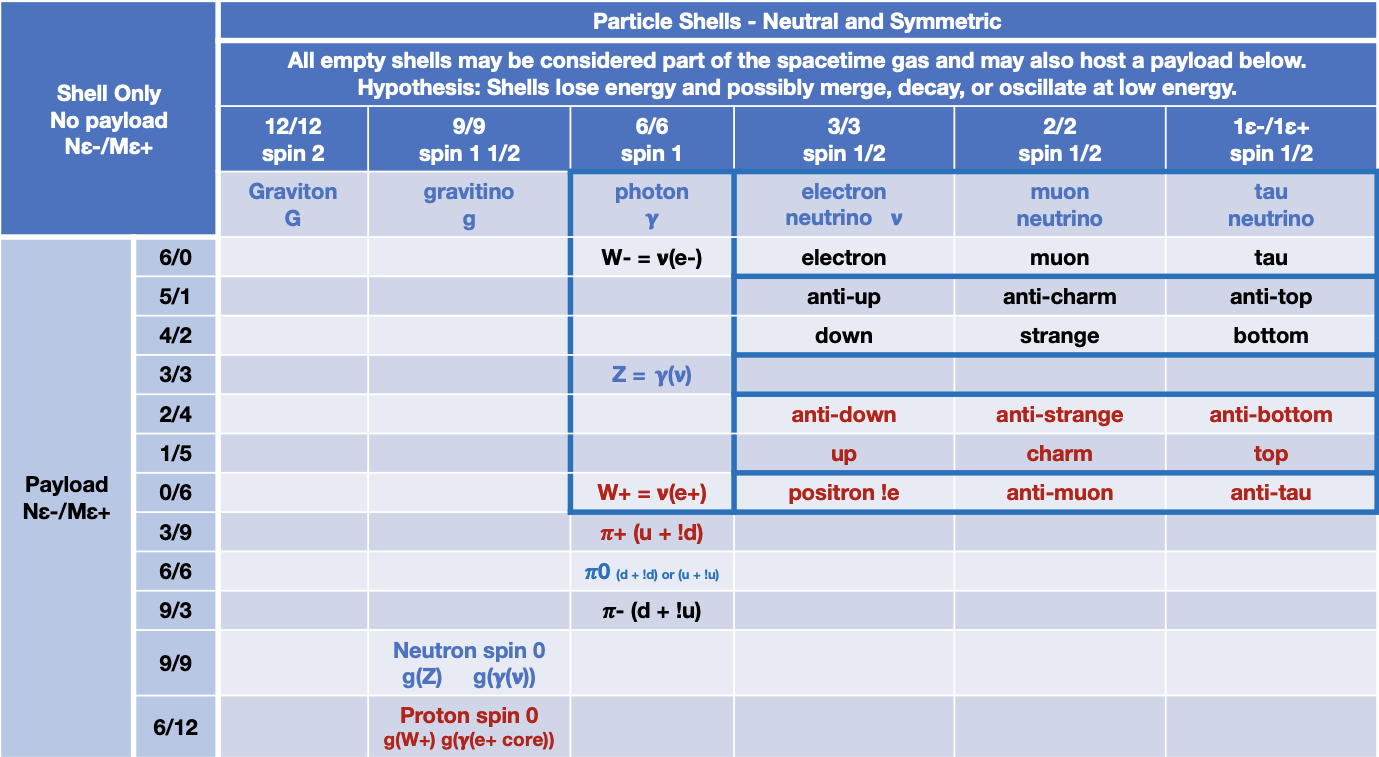
Update January 2022 : Lots of progress shown in the next two charts!
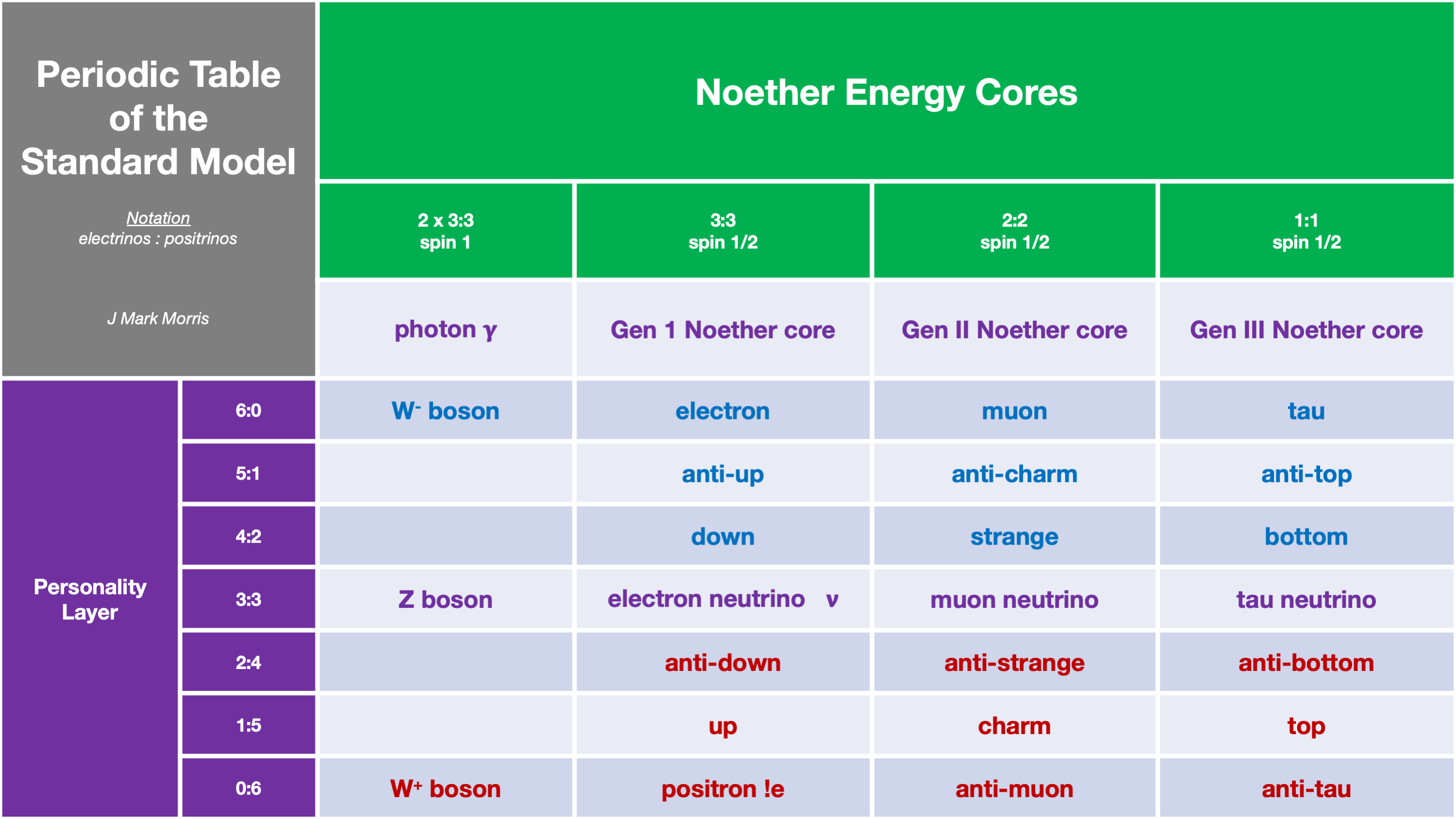
Update December 2022 : More parsimonious implementation model.

I’ve been looking for ways to organize this chart to show the shells. Here is my first attempt.
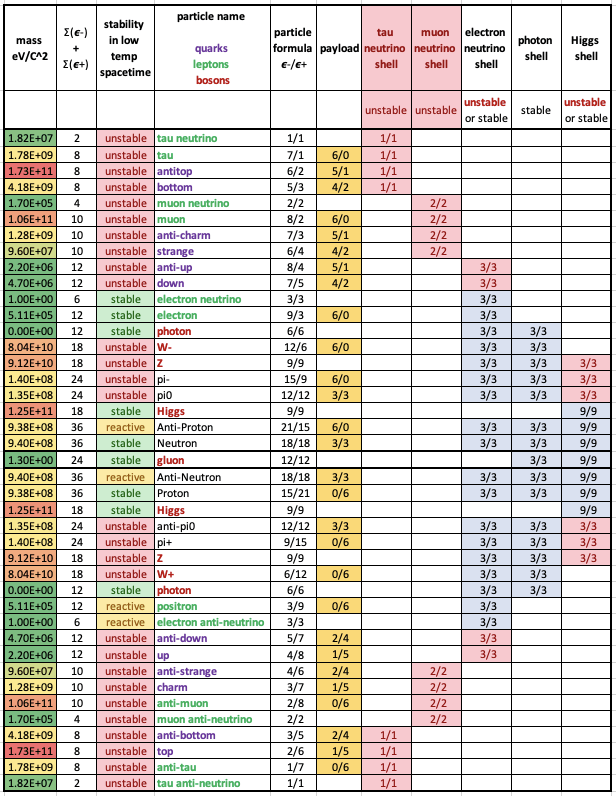
The particle compositions are interestingly symmetric.
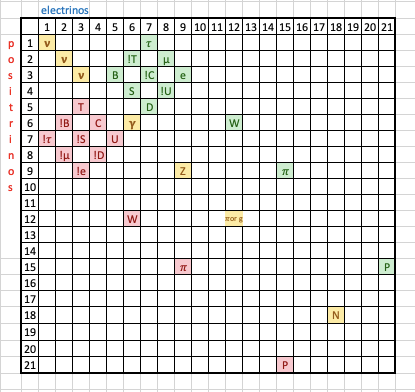
Here is an artwork I made to explore the symmetries of the standard model assembly architecture. It’s imaginative and exploratory.
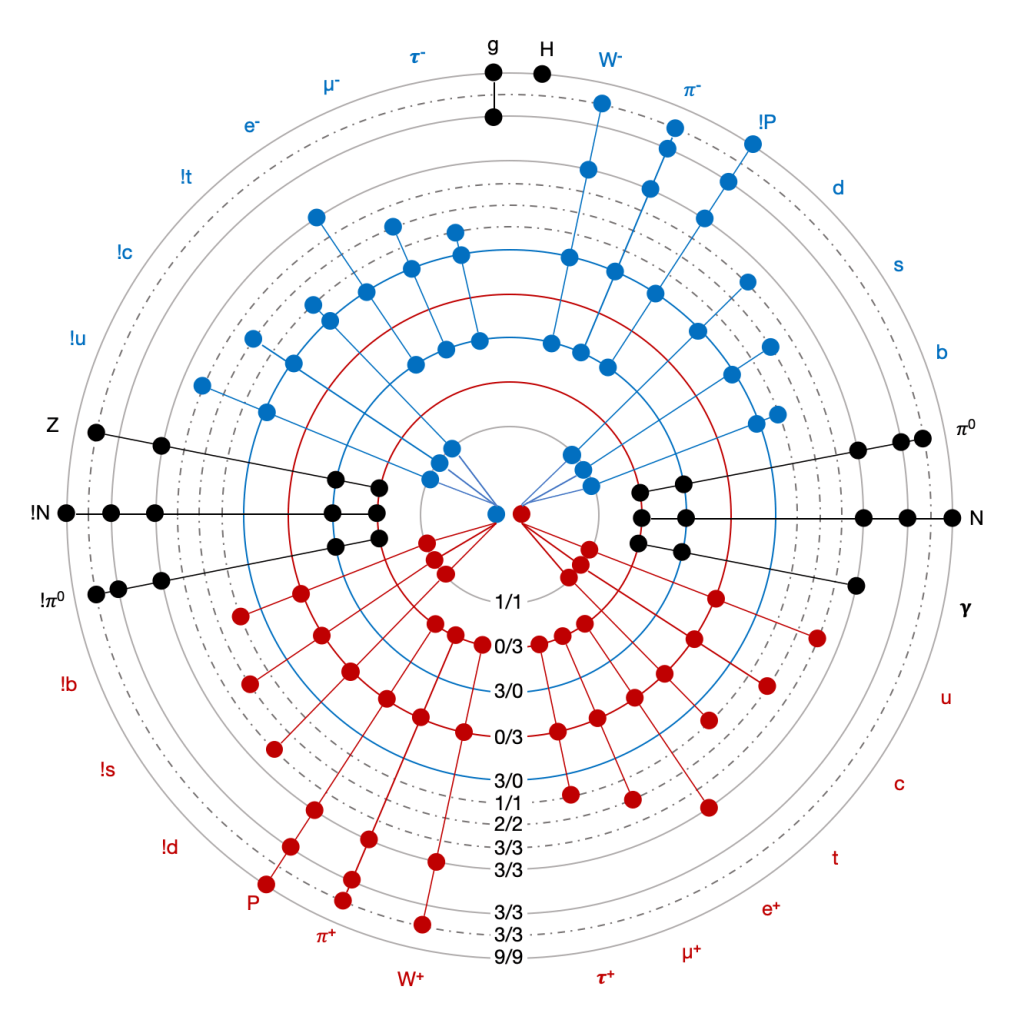
Update January 2022 : Nature is metal. The patterns are all sorting out now. Simulation and mathematics will make everything clear. We know how this story plays out! We know the particles that are stable and therefore we know that simulations and mathematics will validate that reality.

Spacetime is implemented with an aether of low apparent energy particles.
Modern quantum mechanics theory, confirmed by experimental evidence, has identified a great many particles that are considered part of the standard model. Any particle can have a reaction when it collides with another particle. These reactions often cause a particle to decay into other particles which may then react with still other particles to create a new particle. The physics community documents all of these particles, reactions, and decays via the Particle Data Guide, which was originally a book, but now is also available as a web site (http://pdg.lbl.gov/).
GR-QM era science is not aware of spacetime æther and it is not detectable via experiment because of its low energies. Therefore as we examine reaction formulas we must consider that they may be incorrect. They may be missing spacetime particle inputs or outputs. One of the beautiful things about NPQG is that we can use the known reactions to decipher the electrino/positrino formulations for standard model particles. Furthermore we can also detect missing inputs and outputs when we find an imbalance of electrinos and positrinos in a reaction. Using these techniques we can decode the mystery and develop a consistent system of particles.
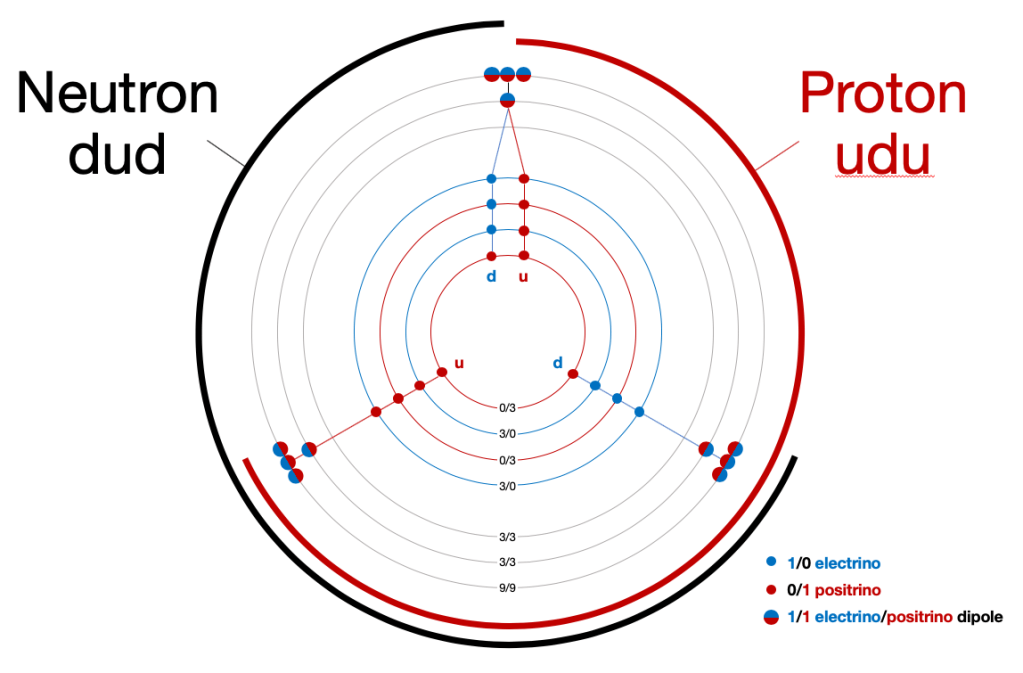
The visual 2D art above ties into the orbital ideas and particle compositions. This art shows an intermediate transition point where an energetic reaction is creating a proton (udu) or neutron (dud) and some particles in each quark have been boosted to more energetic orbits but some of the interior orbits have not yet realigned. Presumably the orbits work together in a wave equation to balance electromagnetic and kinetic energy into a stable particle. I don’t know how often proton-><-proton collisions produce pure quarks, but it would be the case that many different particles documented in PDG could result from a collision. Also since the collider detectors can’t detect spacetime particles (which may include low energy neutrinos, photons, and reaction products of those) those are free inputs and outputs available to make the reaction balance.
𝗡𝗣𝗤𝗚 Notation
First let’s introduce notation. I’ll use standard notation where known. Every particle is composed of electrinos and neutrinos in various proportions. We write a particle formula with electrinos above positrinos.
An electrino ε⊖ or 

A positrino ε⊕ or 


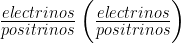
![\frac {electrinos}{positrinos}\; or \left [ \frac {electrinos}{positrinos} \right ]](https://s0.wp.com/latex.php?latex=%5Cfrac+%7Belectrinos%7D%7Bpositrinos%7D%5C%3B+or+%5Cleft+%5B+%5Cfrac+%7Belectrinos%7D%7Bpositrinos%7D+%5Cright+%5D+&bg=ffffff&fg=000&s=2&c=20201002)
| Spacetime particles g : gravatino :   : photon : : photon :   : electron neutrino: : electron neutrino:   : muon neutrino: : muon neutrino:   : tau neutrino: : tau neutrino:  | Quarks u : up:  c : charm :  t : top :  d : down :  s : strange :  b : bottom :  |
| Bosons W- :  W+ :  Z :  | Constituents of Atoms e- : electron :  e+ : positron :  N : Neutron : ![\frac{9}{9} \left ( \frac{6}{6} \left ( \frac{3}{3} \right ) \right ) = \left [ \frac{18}{18} \right ]](https://s0.wp.com/latex.php?latex=%5Cfrac%7B9%7D%7B9%7D+%5Cleft+%28+%5Cfrac%7B6%7D%7B6%7D+%5Cleft+%28+%5Cfrac%7B3%7D%7B3%7D+%5Cright+%29+%5Cright+%29+%3D+%5Cleft+%5B+%5Cfrac%7B18%7D%7B18%7D+%5Cright+%5D+&bg=ffffff&fg=000&s=2&c=20201002) P : Proton : ![\frac{9}{9} \left ( \frac{6}{6} \left ( \frac{0}{6} \right ) \right ) = \left [ \frac{15}{21} \right ]](https://s0.wp.com/latex.php?latex=%5Cfrac%7B9%7D%7B9%7D+%5Cleft+%28+%5Cfrac%7B6%7D%7B6%7D+%5Cleft+%28+%5Cfrac%7B0%7D%7B6%7D+%5Cright+%29+%5Cright+%29+%3D+%5Cleft+%5B+%5Cfrac%7B15%7D%7B21%7D+%5Cright+%5D+&bg=ffffff&fg=000&s=2&c=20201002) |
Proton
A proton is composed of three quarks, two of which are up quarks and one of which is a down quark. Let’s work through the formulation.
P = u + d + u =

There are some patterns emerging here, but it is premature to be certain. It might be that a proton is akin to a spacetime particle shell enclosing a W+ boson. A W+ boson might be akin to an anti core enclosing the personality charges of a positron. Recall that a positron is considered anti-matter and QM is puzzled by why it doesn’t appear in nature. Perhaps it has been right under our noses all along, hiding in protons. Transmutation reactions will provide clues.
Neutron
A neutron is composed of three quarks, two of which are down quarks and one of which is an up quark. Let’s work through the formulation.
N = d + u + d =

It might be that a proton is a spacetime particle shell enclosing a Z boson. A Z boson looks like a photon enclosing an neutrino or anti-neutrino. Recall that an anti-neutrino is considered anti-matter and QM is puzzled by why it doesn’t appear in nature. Perhaps it has been right under our noses all along, hiding in neutrons. These are ideas to ponder.
Beta Minus Decay
A free neutron can decay in a process called beta minus decay where it turns into three particles: a proton, an electron, and an anti-neutrino. Let’s go through the formulas and see if they balance or if there is a missing ingredient sourced from the spacetime æther.
Standard formula for beta minus decay: N = P + W- = P + e– + !v
N ?= P + W-


N ?= P + e– + !v


Beta Plus Decay
Standard formula: P = N + W+ = N + e+ + v
P ?= N + W+


P ?= N + e+ + v

Pi Mesons
pi– = d + !u =
pi+= !d + u =
π0= pi0= d + !d =
π0= pi0= u + !u =




Deuterium-Tritium Fusion
D = P + N
T = P + N + N
He = 2P2N
D + T = 2P2N + N = He + N
We can see that deuterium-tritium fusion balances without calculating the electrinos and positrinos.
There may be a correlation of tri-binary precession and the concept of spin and the mathematics of spinors.
J Mark Morris : San Diego : California
 Neoclassical