I am starting to think that all assemblies are based on nested point potential binaries and that all assemblies that have long term stability have a multiple of six point potentials.
- Neutrino 12 = 6:6
- Electron 12 = 9:3 = 3:3 (6:0)
- Photon 12 = 6:6 = (3:3) (3:3)
- Neutron 36 = 18:18
- Proton 36 = 15:21
Let’s try a new notation and see if it is helpful in our decoding task and help us map the standard model to NPQG. The intent is that it should be evocative of wave equations and imply a potential superposition of wave equations when used in a string to describe composite particles.
- ↑ : a binary
- ↓ : an anti-binary.
- Ψ : a nested configuration of three binaries for 3D containment
- ₼ : an anti configuration of three binaries for 3D containment
- ⋺ : a configuration of three orthogonal electrino pairs
- ⋲ : a configuration of three orthogonal positrino pairs
- ← : a planar pair of contained electrinos
- → : a planar pair of contained positrinos
Our notation will encode particles in a string of these symbols and reading left to right will be from outer most binaries to innermost binaries and will also indicate personality charges. Alright we’re ready. Let’s code some popular standard model particles.
- ↑ : binary and Gen I pro Noether core
- ↓ : binary and Gen I anti Noether core
- ↑↑ : Gen II pro Noether core
- ↓↑ : Gen II anti Noether core
- Ψ : Gen III pro Noether core
- ₼ : Gen III anti Noether core
- Fermion generations (generation + containment binaries = 4)
- Gen I : Three containment binaries
- Gen II : Two containment binaries
- Gen III : One containment binary
- Generation I Quarks : Unstable when not contained
- Up : ₼ ↓→→ : Stable when contained
- Anti-Up : Ψ ↑←← : Unstable when contained
- Down : ₼ ↓↓← : Stable when contained
- Anti-Down : Ψ ↑↑→ : Unstable when contained
- Generation I Electron
- Electron : Ψ ⋺ : Stable when not contained
- Anti-electron : ₼ ⋲ : Stable when contained
- Bosons
- Photon : Ψ Ψ
- Anti-photon = ₼ ₼
- Z : ₼₼ ₼ : anti-photon (anti-neutrino)
- W+ : ₼₼ ⋲ : anti-photon (anti-electron charge)
- W– : ₼₼ ⋺ : anti-photon (electron charge)
- Proton : ΨΨΨΨΨ ⋲
- Neutron : ΨΨΨΨΨ Ψ
- Pi Mesons
- Pi+ : ₼₼₼ ⋲
- Pi0 : ₼₼₼ ₼
- Pi– : ₼₼₼ ⋺
- It would be a mirror image
This new notation makes total sense! I think we can enhance the NPQG formulation table for the standard model now!
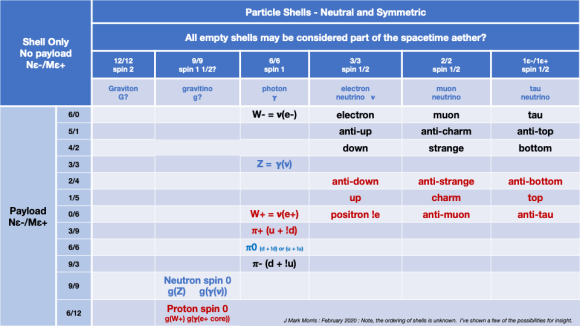
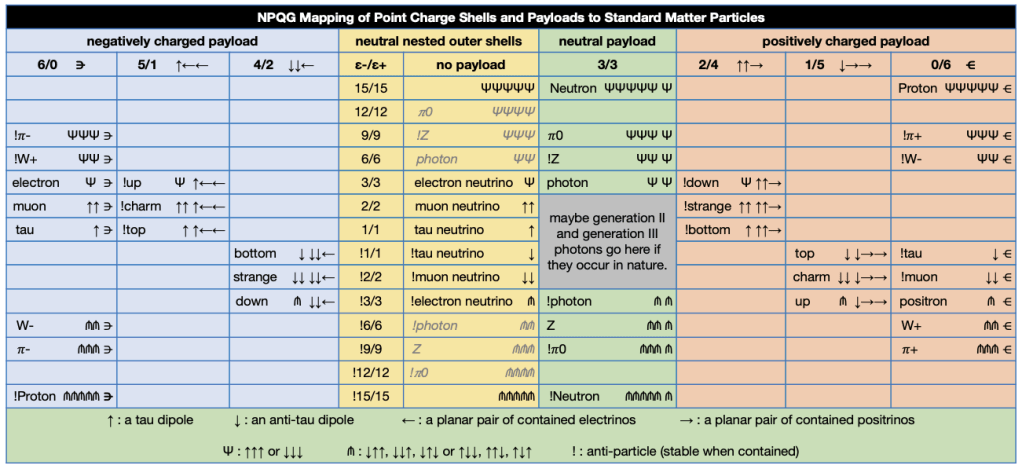
The new formulation table contains far more information about the structure of the composite particles in the standard model. It shows how binaries may form nested shells. It is starting to appear that matter and so-called anti-matter have some kind of incompatibility in the rotational configuration of their shells. In the key to the table I speculate that anti-matter has something to do with orientation. The patterns in the table are very consistent. The table has good symmetry around charge and anti-matter such that you can imagine folding the table in half vertically and horizontally and you see that these two flips and the diagonal quadrants map perfectly. This is promising, but it may not be correct.
I wrote this comment on Dr. Stacy McGaugh’s Triton Station blog:
With respect to the friendly type of physicists and cosmologists and sympathy for astronomers, your fields are incredibly far off track. It is time to unify GR and QM and turn LCDM inside out. How can you even do science when you don’t know any of the following:
1. Universe background = flat space (nothing but dimensions) and linear time (unidirectional)
2. Universe ingredients = equal and opposite, immutable, energy generating and carrying point potentials with magnitude |e/6|.
3. Two free parameters = average volumetric density of point charges and average volumetric energy generated and carried by point charges (both calculated in Euclidean space)
4. The first structure to form is the orbiting binary which is a positive point charge and a negative point charge orbiting each other according to a modified Coulomb’s Law that describes these point charges.
What happens when you do work W on one point charge and apply Planck’s constant h J⋅s of energy in the direction of orbital velocity?
Does each point charge perceive the electric field from its partner to be emanating from a point on a line that goes through the center of the orbit? No.
The speed of the electric field, c, is important.
The orbiting binary is a system that:
a. stores energy in Planck’s constant h J⋅s increments (1 to Planck frequency increments)
b. reduces its radius for every Planck’s constant h J⋅s increment
c. increases point charge fraction of c speed for every Planck’s constant h J⋅s increment
d. reduces wavelength for every Planck’s constant h J⋅s increment
in other words the binary is
i. a 143 bit energy accumulator
ii. a stretchy ruler
iii. a variable clock
iv. the basis of spacetime
The fields of physics, cosmology, and astronomy are lost and getting more lost due to a series of faulty conclusions over the past 133 years. Here is where this model leads:
5. QM’s quantum is emergent. Energy is continuous and structure quantizes it with the binary.
6. QM’s uncertainty is the phase in the binary at one half Planck’s constant h J⋅s which is the tipping point in energy transactions. Hey Schrodinger’s cat just escaped the box!
7. The outer sub-assembly in the core of all fermions is a orbiting point charge binary. It can accept one Planck’s constant h J⋅s every 1/2 revolution. This is QM spin.
8. Einstein’s spacetime geometry is implemented by binaries or assemblies they form.
9. Einstein’s observer needs to move from low energy spacetime to the Euclidean frame.
10. From the Euclidean frame its a lot easier now to see what is happening.
11. Standard matter particles are constructs of point charges.
12. Assemblies generally have a lot more apparent energy (i.e., mass) than spacetime aether.
13. The Noether cores of standard matter assemblies are effectively an alternating current circuit.
14. Gravity = standard matter climbing the gradient of spacetime aether energy.
15. EFE does well at large scales, but the EFE fail at the physical level of point charges.
16. The ONLY fundamental quanta are the point charges.
Huge implications:
17. Bang, inflation, expansion, shrink, bounce are all galaxy local via the SMBH.
18. Koide’s formula describes the field interactions of three orthogonal nested binaries at different radii.
19. Hence the explanations for fermion generations.
20. An electron CONTAINS a muon. A muon CONTAINS a tau. Abundant energy.
21. Each binary shell layer can shield some or all of the energy it encapsulates.
22. An electron neutrino has unstable energy screening. Hence oscillation.
23. Photons are made of point potentials: 6:6
24. Anti-matter cannot survive long in our universe as a free assembly.
25. Anti-matter is only stable if it is in an assembly, like a photon.
27. The strong force is emitted by binaries in each quark.
28. It seems that W and Z are like a can opener for assemblies.
29. No singularities. No wormholes. No many worlds.
30. Multiverse = pocket universe = a SMBH eruption of point charge plasma and recycling.
My intent for the comment was to try yet again to get the physicists to engage with NPQG.
J Mark Morris : San Diego : California
 Neoclassical