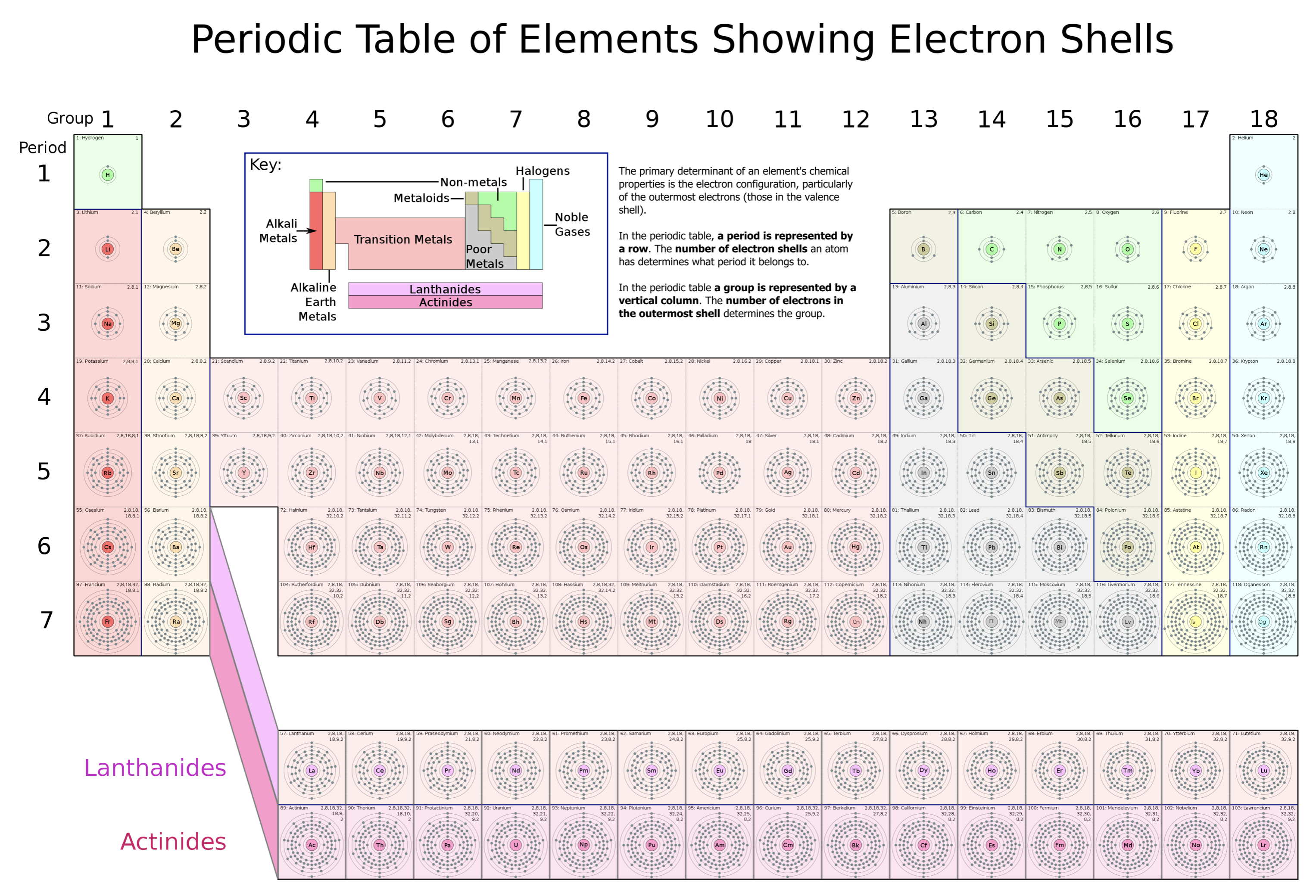
I love this visual version of the periodic table of elements showing electron shells. I love the duality between this form of depiction and my diagram of the point charge implementation of the standard model. You can see how the patterns at the standard model influence the dual patterns in the periodic table of elements.

The way nature assembles itself from a maelstrom of near Planck energy point charges is as follows per NPQG – Neoclassical Physics and Quantum Gravity.
Point charges pair off and orbit each other. The orbiting binary is the first level of assembly. They can decay in reactions. An isolated and unperturbed orbiting binary is an incredibly stable system that would never decay. Orbiting binaries have some really cool behavior. At the Planck energy the velocity of each point charge is near @ pi / 2, where @ is the speed of emitted potential. (@ is what the speed of light c, approaches, but that’s a topic for later). As orbiting binaries dissipate energy, their frequency drops and their radius increases, and the velocity of the point charges decreases. As the velocity drops from @ pi / 2 to @, the binary inflates rapidly. When the velocity of the point charges is v = @ that is the symmetry breaking point where the point charge is traveling at the speed of its own potential emissions. As velocity drops below @ the binary continues expanding but not as rapidly as the inflation phase.
Orbiting binaries have a polar axis and the potential swirl around that axis creates a powerful vortex. Binaries somehow capture each other by getting their vortices entangled. The nested binaries could be considered to have a common co-moving center. Since the background space is three-dimensional, binary capture reaches a relatively stable assembly when there are three generations of binary nested. It turns out those three binaries are at vastly different energies, radii, and point charge velocity. This is the basis of the fermion generations. The triply nested binary is what I call the Noether core, named after Emmy Noether. The Noether core is the basis of all stable particle assemblies in the universe, including Higgs particle assemblies which implement Einstein’s spacetime. If you are linking the shape shifting behaviour with energy to Einstein’s general relativity you are on the right track. Besides the radius of Noether core binaries changing with energy, the shape of the Noether core assembly changes with group velocity. Of course it does, because of point charge path history. A point charge never experiences another point charge (or itself) where it is NOW, but always from a position on that other point charges path history where the potential was emitted that is causing action NOW.
Now we have Noether cores and we still have those vortices. There are three orbital axis, and therefore six polar vortices. Also, the maelstrom that this process started out is now far more spread out and less dense and energy has dissipated and transferred and reactions have happened and there are a bunch of lower energy point charges flying around with no role yet. It turns out they like to nestle in those polar vortices of the Noether core. Take any combination of six point charges and you get a standard model fermion. Six positrinos decorating a Noether core = a positrino. Three of each = neutrino. And so on to make the quarks and the electron. I skipped over it, but there are also anti-Noether cores and those are the basis of the anti-particles.
The bosons are a bit more exotic. The photon is really awesome. It is a contra-rotating coaxial planar pair of Noether cores. Their contra-rotation causes cancellation by superposition of the emitted potential thus producing the familiar electromagnetic wave. This particular fact was actually known in 1898 by the way! Another enormous clue missed by science. The W and Z bosons are more ephemeral intermediate assemblies in a reaction and sometimes they are created from the inputs to a reaction as well as a Higgs from spacetime.
So there you have it. Nature is reasonable parsimonious and the way assemblies build up is quite straightforward to understand. But why do some assemblies survive and other’s don’t? One big reason is shielding of energy by superposition. The orbital paths and the precession of the the binaries in the Noether core shield the energies of the interior binaries. How does that work? It’s just cancellation by superposition. Remember these binaries are orbiting at extremely high frequencies, especially the higher energy binaries. They are constantly emitting new spheres of potential that expand at field speed @. Any point in space is going to be totally buffeted by positive and negative potential spheres which originated from various constantly changing distances in the assembly. The net effect is to shield energy and that gives the assembly a degree of stealth. High energy assemblies are highly reactive. The assemblies that emerge from the maelstrom are the ones that survive. Survival of the fittest. How do you survive as an assembly of point charges? By not decaying in a reaction. How do you avoid those reactions? By hiding the vast majority of your energy.
J Mark Morris : Boston : Massachusetts
 Neoclassical