I began my thought experiments on nature in January 2018. The genesis of my ideas was skepticism about the theory of black holes. Following one thread after another, often in a highly non-linear fashion, I scoured the landscapes of physics, cosmology, and astronomy and found these fields to be in deep crisis and confusion with paradoxes and major open unsolved problems galore.
Eventually I realized that technical and narrative false priors had resulted in the field of physics setting aside the search for the base truth of nature and instead turning to “effective theories” that led to technological progress but didn’t resolve the conundrums. The original false prior seed in classical physics grew into an enormous tree of false prior narrative that casts shade on the entire fields of physics, cosmology, and astronomy.
Throughout my explorations, I had the strong intuition that two immutable point potential emitting (charged) objects were the solution. That immutability could potentially be an inherent characteristic, or it could be a natural limit on the closest approach — an asymptotic safety at the foundation of nature. Immutability is a very powerful concept that immediately solves problems such as singularities in black holes, resolving my original skepticism. As I continued my journey, I relentlessly sought to define my point potentials and map them to the existing science.
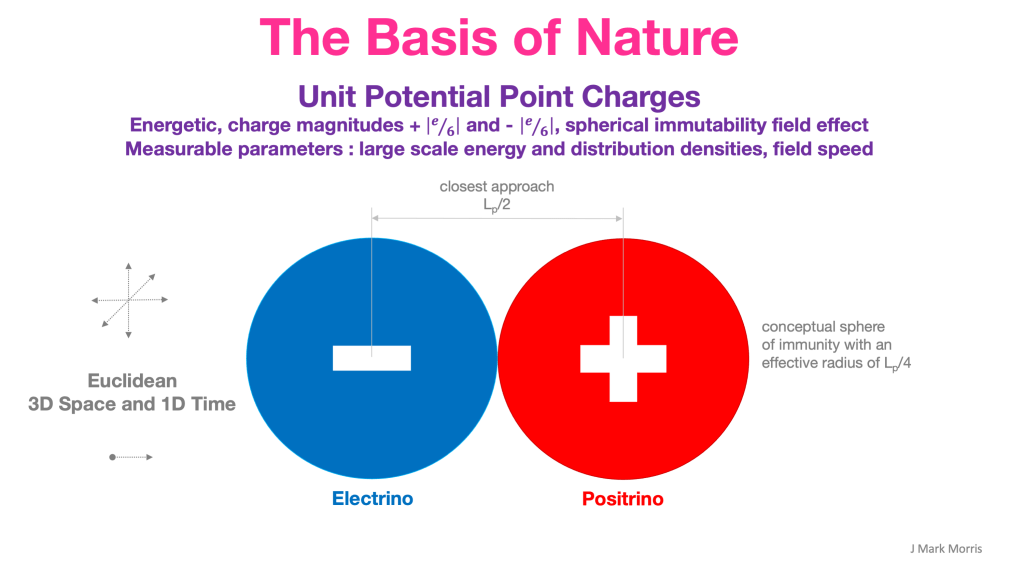
My thought experiments have led to the idea of the positive and negative point potentials which emit Dirac sphere potentials that expand at velocity @ and have a radial magnitude |δ/r|, where r = @t, emitted along the unit potential path history in absolute Euclidean time and space. The velocity of the unit potentials also plays two key roles, first in establishing the gradient of the Dirac sphere potential stream, and second in determining the action when a unit potential encounters a Dirac sphere emitted by itself or any other unit potential. That’s pretty much it. Nature is really that simple at the foundation. Emergent assembly does the rest.
You’ll notice that the speed of light, c, does not appear in the foundation of nature. Why? The reason is that light is made of photons, and photons are assemblies made of unit potential point potentials. It appears that photon assembles sail on their own scalar and vector potentials, or rather that the accumulated action from each of the point potentials in a photon on themselves and their partners in the photon assembly serves to both propagate the photon and couple the assembly together. Thus the speed of light, c, is really an effect, not a cause. In low energy spacetime aether, the photon speed, v = c, approaches the speed of the Dirac sphere potentials v = @, but can not exceed it at the assembly level.
The implications are that science has erred by smuggling the speed of the photon, c, into fundamental equations, such as those of Jefimenko and Liénard–Wiechert which are derived from classical point charges. This in turn has caused a huge miss of a major sector of physical dynamical geometry that describes nature and causality, the idea that the unit potential velocity is not constrained by the speed of the photon c, or even by the speed of the Dirac sphere potentials @. Instead, it is possible for the unit potential point potential velocity to exceed @ and this leads to enormously powerful new insights about nature and causality.
What are the next steps now that the base architecture of nature is postulated as I have set forth above?
- Develop the dynamical geometry of point potentials. This is a simple geometry in Euclidean time and space where action on a unit potential defined by (potential polarity, time, s = position, s’ = velocity) occurs on a Dirac sphere in a Dirac sphere stream that was emitted along the path history of a point potential. The summation of all actions, including self-action, tells the point potential how to move.
- Visualize point potentials behaviour and assembly with animated simulation. The tool I have chosen is OpenGL with coding assistance from BingAI. OpenGL will be a good choice for scaled-up higher performance simulation of assembly formation.
- Share the knowledge of the point potential universe via a structured online book-like format as well as educational videos. This outreach material will be live and dynamical with frequent updates as I find better ways to convey insight with parsimony.
As I embark on this new phase, I will probably write fewer blog posts, and instead focus my energies on the online book, animated simulations, and educational videos.
NPQG is an open source effort. Feel free to leverage the insights and contribute your advancements as you see fit.
As always, I would be happy to converse. You can reach me via email at inquiries@neoclassical.ai
J Mark Morris
 Neoclassical