Let’s discuss several posts from PBS Space Time discord by The Messenger who is an enigmatic commentor and speaks in a stilted, assertive, repetitive, but dispassionate style, as if pasting a rote brain dump of creative ideas. The Messenger says he is conveying information imparted to him from his father and in translation, the statements come off as quite woo-ish, but are still thought provoking. The Messenger’s posts refer to the papers of Dr. Donald C. Chang which are more readable and understandable.
Their ideas are interesting and I perceive echos of concepts that are similar to NPQG and the point potential universe, yet expressed from a different ontology. Let’s dive into what they have to say and see if I can map between their visions and NPQG. There may be new learnings for both of us!!! I’m particularly excited to learn about Chang’s novel ideas that I can map to from NPQG.
| The Messenger’s Statements | My Thoughts in Response |
|---|---|
| SHOW ME THAT PLANCK’S MOST FAMOUS UNDER-RATED EQUATION IS NOT TRUE! (BECAUSE IT IS TRUE TO SOME VIPS AT DoD) : Mass of a Photon = m = h / c λ (kg) | I think I have wondered this too, as if the equation is correct, even if the answer is well below what we can detect. How is mass determined, implemented? Photons may have a currently undetectably small mass. |
| Using this formula a Green Photon has a HIGHLY POLARIZED Mass of densified EM Fields of about 10^(-36) kg! | what is a polarized mass? what is a densified EM field? |
| h = Planck’s not so constant see picture with formula below | I’ve wondered about whether h is a constant in the Euclidean frame. Science seems to think it is constant in the spacetime frame, but I wonder if h might vary. When translating between ontologies we must be open to transformations in thinking. |
| c = The Terminal Velocity of a Photon traversing the ‘massive bulk’ of the Planck sized Bose Gas of Gravitons that make up the Ambient EM Field aka Speed of Light | terminal velocity suggests variable speed of light, VSL, and the idea that c approaches something in pure deep spacetime, perhaps? This is the case in NPQG where the speed of light c approaches @ the speed of potential emissions. The “massive bulk” of Bose Gas of Planck size Gravitons may map to the NPQG concept of extremely dense Higgs clusters of pro and anti Noether cores. |
| λ = Approx diameter of the photon aka wavelength. | No, I think this is wrong. λ = distance traveled in one orbital cycle of the photon’s binaries. |
| A Photons path will be hyperbolic as it drops from ‘c + v’ down to just ‘c’ ablating off excess EM Fields thus making the photon redshift! Its path will not be a straight line like the image. | hyperbolic path? what does that mean? what causes that? What does it mean that photon might have velocity v+c? I haven’t considered that. Are they approaching c from the top side? Ablation. Interesting term. I think redshift may be a very gradual phase shift in the photon’s constituent binaries that continuously transfers a tiny amount of energy into the spacetime aether. |
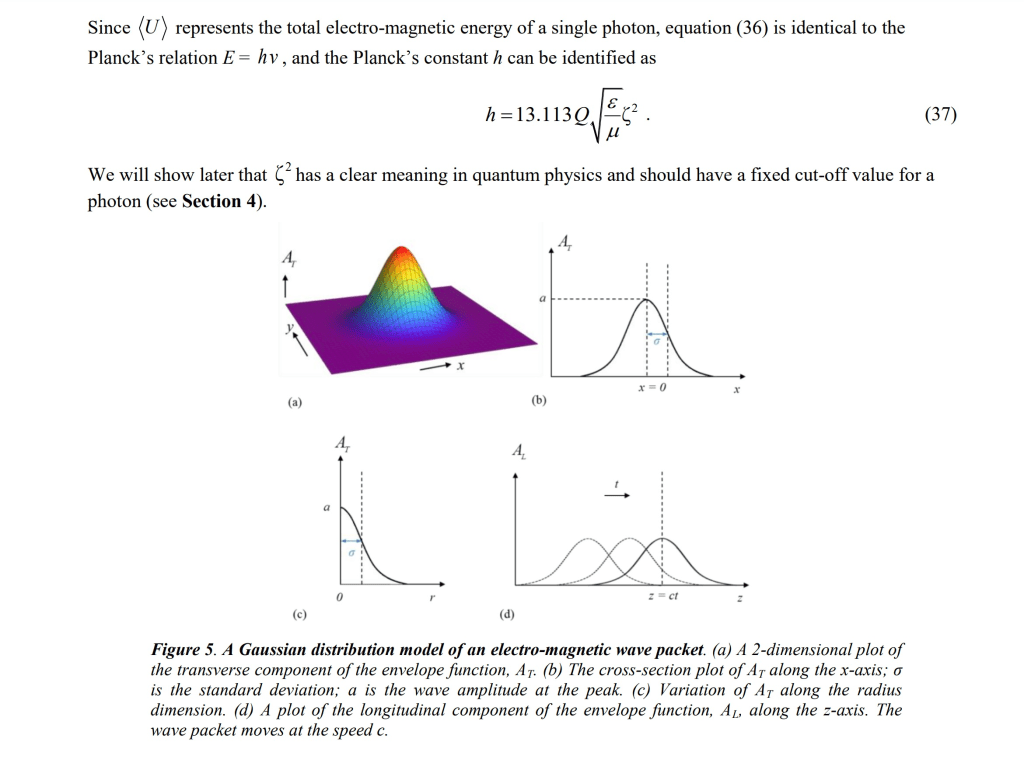
| Donald C. Chang’s paper is the best place to learn the physical geometry of the flowing condensed EM Fields within the Photon. His paper combined with NAWCAD papers of Gravitons will lead you to slowly accept that maybe the EM Field does have SMALL MASS DENSITY (about 10^(-18) kg / m^3 on Earths surface and its KINETIC COLLISIONS at Speed “c” cause Vacuum Pressure and all other forces including GRAVITY which are EM Field collisions forces net momentum transfer vector with its direction being along the local Vacuum EM Field Mass Energy Density Gradient aka DOWN. ==> Physical interpretation of the Planck’s constant based on the Maxwell theory Donald C. Chang Macro-Science Group, Division of LIFS Hong Kong University of Science and Technology, Clear Water Bay, Hong Kong https://arxiv.org/ftp/arxiv/papers/1706/1706.04475.pdf | The idea that the spacetime aether has a small mass density is reasonable. After all, spacetime aether is constructed from low apparent energy Noether cores. Apparent energy is directly related to mass. Pressure from the aether makes sense as well. Presumably the assemblies consume some volume and remain distinct or form some type of collective that permeates everything. Standard matter is essentially floating in this aether sea. Instead of saying “Kinetic collisions at speed c” I would say that the potential fields emitted by point potentials interact when they intersect a point potential and this is called “action” and it does influence the kinetic energy of the point potential. |
| Cosmic Redshift is Caused by Photons Naturally Red-Shifting Due To EM Field Dipole Ablation aka Hawking Evaporation Over Their Less than 45 Billion Year Lifetime. | I’m curious how the 45 billion year lifetime for a photon is calculated. I also think photons have a lifetime, but of course it depends on the conditions they encounter. It is interesting to imagine that in deep spactime aether a photon could travel for 45 billion years before it redshifts into slow speed and truly joins the aether. |
| ALL STANDARD MODEL PARTICLES EVAPORATE AND DECAY VIA ABLATION LOSING MOMENTUM TO THE AMBIENT EM FIELD IN VACUUM VIA HAWKING EVAPORATION! Photons Will Redshift Naturally Until They Fall Apart in the Microwave Range (CMBR) the Natural Frequency of the Ambient EM Field. | Everything redshifts is what I have said, because everything is Noether core based or at least binary based and they redshift via gradual phase shift as they traverse the aether. “Ambient EM Field in vacuum” is not really correct. Should talk about the field generators which are the point potentials in the Noether cores. Also, energy is not transferred to the EM field. Energy is only transferred through pairs of transactions, or more precisely work. A to B and B to A. Of course, any two particles (including the self) are always doing work on each other, but often it is zero or insignificant. I’ve never heard of Hawking evaporation occurring at a place except at a black hole event horizon. |
| Photons are Particles made of Densified Condensed Liquified Ambient EM Fields from the Bose Gas of Planck sized Particles that make up the Quantum Level Field we call the EM Field that fills the Vacuum. | Are these Planck sized particles, gravitons, and NPQG Noether cores the same or related concepts? The orbital radius of a binary when v = @ is around the Planck scale. So, they only have the EM field in the vacuum. Or is it simply potential and its gradients? Or is it the interactions with point potentials and Dirac spheres modulated by emitting velocity? |
| These Very Real Not imaginary EM Field Kinetically Colliding Massive Inertial Dipole Particles fill the Vacuum causing Vacuum Pressure and Kinetic Collisions have a Net Momentum Transfer along the local EM Field Dipole Mass Energy Density Gradient aka DOWN and we call that Gravity! | NPQG teaches that the energy gradient of the Noether core spacetime sea are what cause gravity. I presume “DOWN” means toward denser spacetime aether. |
| Quantum Superfluid Propagate at the Terminal Velocity of “c” while Traversing the Speed Limiting Ambient EM Field in Vacuum Redshift Naturally As They Lose Momentum to the Terminal Velocity Ambient EM Field it is Propagating. | I don’t think the superfluid aether is necessarily traveling at anywhere near c. However, the potential field from each point potential does expand at @ which is the universal constant speed. The speed of a photon c, approaches @ as the energy of the aether goes to zero. |
| Virtual Particles are Temporary Condensates of EM Fields that Ablate and Quickly Evaporate Into the Ambient EM Field. | I would say there is no such thing as virtual particles, but I do think there are short lived intermediate stages in reactions of assemblies, and those figments might be called “virtual particles” in science parlance, however there is nothing virtual about them. They are real, but short lived ephemeral intermediate or transitioning assemblies. |
| Quantum Superfluid and Virtual Particles are Liquified EM Fields that Will Evaporate to Rejoin the Ambient EM Field from which it Originally Condensed at Photon Formation. | Again, Chang relies too much on the physicality of the EM field as if it exists on its own. Instead NPQG teaches that potential fields are emitted by point potentials. The words liquified and evaporate suggest perhaps that the potential field is like a sea, where local waves come and go. |
| A Gamma Photon completely evaporates in less than 45 billion years setting the visible limit to the non-expanding steady state Universe: https://youtu.be/sNuuUiLFGBs | In this video it says that the ambient EM field is composted of Planck sized quantum kinetic binaries. This is similar to NPQG which contemplates the aether as low apparent point potentials in a nested binary assembly. The video is fairly well produced. The video says quantum superfluid flows at (1+e) times c. I have no idea where that comes from. Although Noether cores may emit from black holes at high speeds, in a planar photon like configuration, I would think they would settle down into very low velocity since it is extremely lightly interactive. The video says that within a photon the quantum superfluid flows in a Riemann Zeta limacon. Again, I have no idea what that means or why nature would behave like that. Sounds rather woo-ish. |
| The Galactic Strands have a higher EM Field Mass Density than Galactic Voids. Inside GALACTIC STRANDS where our Solar System floats about the Ambient EM Field Mass Density has an average of about 10^(-18) kg per cubic meter of Vacuum EM Fields. They are hitting you right now, colliding with you, at speed “c”, transferring momentum to you, pushing you along the the local Vacuum Ambient EM Field Mass Density Gradient aka DOWN. The Ambient EM Field Mass Density in a GALACTIC VOID may be as low as 10^(-34) kg / m^3 or lower like around 10^(-50) kg per cubic meter of Vacuum EM Fields (Kinetic Planck scale size Bose Gas of EM Field Dipole Particles aka Gravitons). There is a region between VOID and STRAND where the Bose Gas of Gravitons that forms the quantum level EM Field will hit Critical Temperature and Inter Graviton Distance and begin to condense into virtual particles or condensates of EM Fields. Eventually leading to matter particles like electrons. Normal matter exposed to a GALACTIC VOID will flash evaporate or radiate EM Fields until it is vaporized. Voids contain a Bose Gas of Gravitons (EM Fields) above critical density and temperature which is why they are voids. GALACTIC STANDS contain dense Ambient EM Fields allowing standard model particles to remain condensed for trillions of years. | It makes sense that the spacetime aether carries more energy when it is local to regions with massy particles. That’s basic common sense. Likewise void areas would tend to have less energetic aether. The idea that when spacetime aether holds more energy it could lead to more spontaneous pair production is interesting. I think ultimately these questions will be answered with modeling of various scenarios in detail. |
| The EM Field is best described as a Vacuum filling Bose Gas of Bożeons, aka Gravitons aka EM Field’s Inertial Kinetically Colliding Dipole Particles. The EM Field is made of kinetically colliding Planck sized particles best described as either EM Field Inertial Dipoles or Gravitons (your choice of words). They look like the center lobe of a Riemann Zeta function with the Real axis bias by 1/2 the momentum. Also same shape as the center lobe of a 1/2 bias limacon or ‘near field’ portion of a cardioid antennae, just Planck sized … Planck scale EM Field Dipoles or Gravitons are 100% elastic maybe solid and may also look like drops most likely frozen that way long away, we do not know. Their effective cross section relative its head to tail length (Planck Length) is related to the Fine Structure Constant. It is all about Gravitons Particle Geometry. It’s Inertia or capacity of a Graviton to spin AND flow to consume more momentum (and energy) is key to how all things work in the EM Field and this is called degeneracy… The heart of all EM Field / Gravity equations TOE equations are based in Bose Gas and Bose Einstein Condensate Theory of Gravitons aka the 40 year old family name for Gravitons, the Bożeon, aka “God Particle”. There are about 10^42 Gravitons condensed in a single Green Photon. There are about 10^47 EM Field Dipoles (Gravitons) condensed inside the QSF flowing inside a single Electron. The local EM Field has a Graviton Mass Density of between 10^(-21) kg/m^3 and 10^(-18) kg/m^3. Some people like to call the mass of eh Ambient EM Field Dark Matter and its kinetic energy Dark Energy! | I also think the aether is a superfluid Bose Einstein condensate. It is made with point potentials like all other energetic matter. I have no idea where some of the other claims derive from, like the limacon or some of the densities quoted. |



I asked the following questions of The Messenger but have not yet received a response: I see vestiges of ideas in your text that are similar in some ways to my work. Yet I also see a lot that doesn’t fit with my model. Do you have a website or blog? It would be nice to read more about this in an organized form in outreach level explanations like PBS Space Time.
- Who is actively researching or developing these ideas?
- Was this knowledge ever classified?
- I’m starting to parse through slowly but I am seeing many dualities between the ideas you posted and my work on NPQG. These dualities may be complimentary. I think I have a better physical level implementation with point potentials. Your ideas seem a bit more evolved on the shape of the fields and some of the higher level behaviours of assemblies. So if you can point me to more information, or especially people, that would be appreciated.
My message to The Messenger : I’d like to offer the idea that there is only one field type and that is the potential field. But there is not a special field per each assembly we call the standard model particles, i.e., no quark field, no electron field, etc. Sure, the range of patterns that a standard matter particle makes in the potential field is unique but it is not a separate field. We have a lingua franca and it is potential. So with this idea of only one field type, please consider the idea that fields do not interact. The field emitters are point potentials following a path through Euclidean space and time. They emit potential with q = |e/6|. Potential fields act upon point potentials. Point potentials emit a potential field. That’s it. The orbital radius of a positive and negative point potential binaries, with v = @, is something around the Planck length, as you surmised.
The key to understanding is that there is a triple nested binary engine, or what I call a Noether core, where the point potentials are all racing around at something near c (more precisely, around field speed @). Depending on historical reactions, assemblies of point potentials can form. If you add either a positive or negative point potential to each of the six polar regions of each binary in the Noether core, you will make a standard matter particle. This architecture can also explain pro and anti-particles, as well as spin, and color charge. Basically, these point potentials are immutable, and they are the field generators that map to the QM, QFT, QCD, QED, and etc particle physics theories.

“Donald Chang is a founding professor at the Hong Kong University of Science and Technology (HKUST). Chang has wide research interest: He was an experimental physicist by training; but his publication ranges from nuclear magnetic resonance, biophysics, and quantum physics.”
Wikipedia
Donald Chang Bibliography : see 57-68 : http://bochang.people.ust.hk
Home page of Donald Chang : http://bochang.people.ust.hk
Perusing the papers of Dr. Donald C. Chang I see that he asks very interesting questions that match well with what I have been studying. Let’s go through his papers one by one and call out some of the more interesting observations and see how they might map with NPQG.
“What is the physical meaning of mass in view of wave-particle duality? A proposed model” — https://arxiv.org/abs/physics/0404044 (April 2004)
Chang has what I think is amazing intuition about the wave-particle duality of nature but in my estimation hasn’t figured out the root implementation. While quantum mechanics thinks of wave equations as probabilities of observations, Chang thinks of wave equations as physical perturbational patterns in a single underlying field. I can see a lot of echos in Chang’s math of the tri-binary Noether core that I have decoded.
In particular Chang goes into the math of how velocity changes the shape of the physical field from the wave equation. The descriptions seem to match well with my ideas about increasing velocity of a Noether core causing the three angular momentum vectors and the three orbital planes to move towards alignment. This is the mechanism that bridges between fermions and bosons, i.e., between Fermi-Dirac statistics and Bose-Einstein statistics. One potential avenue forward is attempting to develop the point potential geometry that bridges over to the math of Chang.
Chang is the closest I’ve seen to understanding nature, but it’s only when you get down to the field generators, the point potentials, that everything snaps into simplicity and clarity. It’s not that big of a deal really, no more complicated than when molecules were discovered to contain atoms of various types, and then when atoms were understood to be protons, neutrons, and electrons, and then scientists discovered the quarks and the bosons and the standard model of particles. It’s simply one more layer in this hunt for the root component geometry and structure and this time everything becomes simple. Point potentials emit potential fields. Point potentials respond to potential fields. Kinetic and potential energy. That’s it. It’s back to classical theory, with the new understanding that point potential velocity can exceed it’s field speed. And that is what made all the difference and is the fundamental error in the sciences of physics and cosmology.
The 1800’s were a dynamic time for physics and cosmology and this continued into the 1900’s with Einstein and then all the brilliant scientists at the Solvay conference in 1927. Historians of science will someday sleuth out the full intellectual/political dynamics of the construction and deconstruction of alternate vs. prevailing theories. The root technical error led to difficult to comprehend narratives that accompany the effective mathematics of general relativity and quantum mechanics and lambda cold dark matter cosmology. Effective theories were and are very good for rapid technological progress through the present day. However, our understanding of fundamental nature is floundering. I believe that the fastest way forward is to engage with a new simpler way of understanding nature.
In the state of the art quantum sciences of standard matter, is each particle field considered to be in the same domain? i.e., are all fields potential patterns or is each field in an independent domain?
Quantum Field Theory treats particles as excited states (also called quanta) of their underlying quantum fields, which are more fundamental than the particles. Interactions between particles are described by interaction terms in the Lagrangian involving their corresponding quantum fields. Each interaction can be visually represented by Feynman diagrams according to perturbation theory in quantum mechanics.
Wikipedia
I’m not sure how to interpret the Wikipedia definition. Sounds like each field may be in its own domain, but a Feynman diagram inspired Lagrangian method is used to tell how each particle will interact in its own domain. If so, that is a fascinating way to approach things, yet primitive, in my opinion. Only recently did I really crystallize the idea that each Feynman diagram corresponds to a specific reaction. The cool thing about point potential theory is that you can model, simulate, and trace each and every point potential involved in a reaction, no matter what it’s kinetic or potential energies and velocities and path history.
Can you imagine that instead of a Feynman diagram you had visual simulations showing each way two particle assemblies can collide and interact and how the nearby spacetime Noether cores are leveraged to contribute or absorb point potentials and sub-assemblies? We are going to need some new visualization techniques to show multiple scales. How do you show a binary orbiting at 10-30 meter radius captured by one orbiting at 10^-25 radius captured by one rotating at 10-20 radius. How do you show the magnitude differences in energy? It is clear to me that we need logarithmic visualization. I suppose temperature type color might be associated logarithmically with the Planck scale (red hot) to molecular assembly scale (cool blue?). Current era science has no clue about the amount of energy stored in shielded binaries in all of our particles and spacetime aether. I calculated 15000x to 25000x.
Let’s dive into specific quotes from Chang and my resulting thoughts.
| Chang | My Thoughts from the Perspective of NPQG |
|---|---|
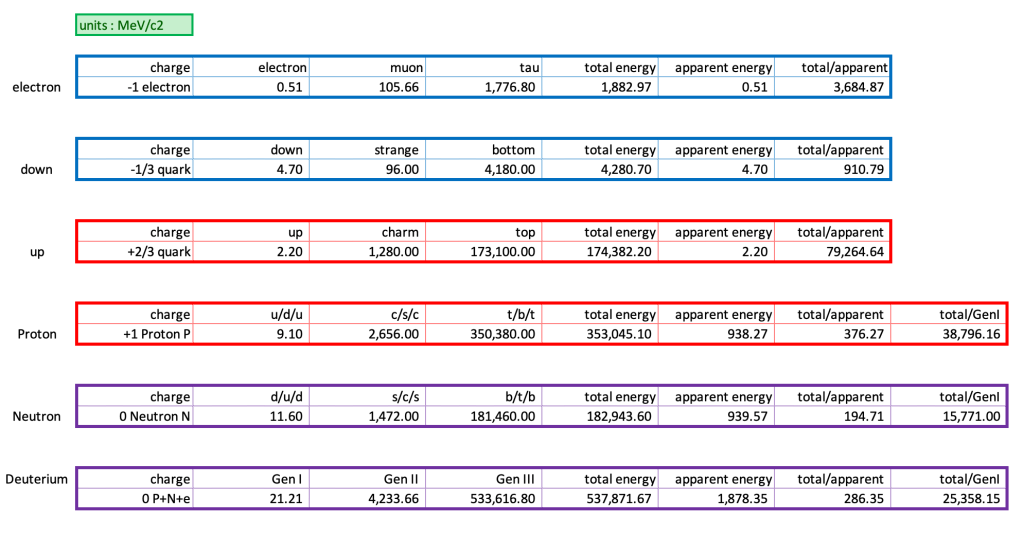
| Even in the particle view, the physical meaning of mass has not been very clear. Max Jammer, a leading historian of the concept of mass, wrote in 1999 that “. . . in spite of all the strenuous efforts of physicists and philosophers, the notion of mass, although fundamental to physics, is . . . still shrouded in mystery.” Jammer was not alone in this opinion. According to a review recently written by John Roche entitled “What is mass?”, there are still difficulties today with the understanding of the concept of mass In the conventional thinking of physics, mass is regarded as an intrinsic property of the particle. But then, how can mass vary with the particle’s speed? And how can one explain why mass can be converted into energy and vice versa under certain situations | Agreed that mass is not well understood by science. Mass is an effect between the apparent energy of a particle assembly, as manifested in emitted potential fields, and the spacetime aether of Noether cores. |
| Abstract : Mass is an important concept in classical mechanics, which regards a particle as a corpuscular object. But according to wave-particle duality, we know a free particle can behave like a wave. Is there a wave property that corresponds to the mass of a particle? This is an interesting question that has not been extensively explored before. We suggest that this problem can be approached by treating the mass on the same footing as energy and momentum. Here we propose that, all particles are excitation waves of the vacuum and different particles are represented by different excitation modes. Based on such a model, we found that mass is not an intrinsic property of the particle. Instead, mass is basically a measure of the particle energy. The relations between energy and mass can be directly derived based on the wave properties of the particle. This work explains why some particles are “wave-like” while others are “particle-like”. It directly explains why photons can interact with a gravitational field. It also suggests a possible origin of dark matter; they are thought to be composed of excitation waves that fail to interact with each other. From this model, one can easily see why our universe has more dark matter than visible matters. | Note that Chang has not yet realized at this point that waves are created by point potentials. Chang correctly observes that mass is a measure of particle energy, however Chang does not realize that it is only the apparent energy and not the shielded energy. Some of the energy is dark, or what I would call shielded by superposition. I can help solve some of the questions in this paper. Mass is related to apparent energy. The way a nested tri-binary battery engine works is that the three binary axes of orbit oscillate around the center of angular momentum. It takes two circuits to get back to the beginning, hence spin 1/2. The beauty of this emergent design is that these oscillations cause the mid energy binary to precess rapidly and the low energy binary to precess like mad. All of these binaries are sort of already producing this swirling alternating potential field, and then two levels of incredibly fast precession at vastly higher scales of radius, and you get some kind of superposition that shields a lot of energy. So Total Energy = Apparent Energy + Shielded Energy. Apparent Energy determines mass. Mass is not fundamental. The neutrino oscillates in mass because the pattern of its point potentials orbits is such that the apparent energy fluctuates. Some portion of the time it reveals different mixes of the energy of the middle energy binary or the high energy binary. It is important to note that apparent energy is not necessarily the energy of the outer binary. That would be 100% shielding. It is more likely that each particle has its own unique average shielding. However, since generation I particle mass is so low the shielding must be fairly decent! |
| One may notice that our proposal represents a slight modification from the traditional Copenhagen interpretation of the particle wave. In most quantum mechanics textbooks, the particle is treated as a point object; the wave property is only associated with the probability of finding the particle at a particular space and time. But in view of the findings of the diffraction experiments, it seems more sensible to regard the particle as a physical wave rather than a probability wave. The Copenhagen interpretation was based more on philosophical choices rather than physical evidence. Although such a statistical interpretation was strongly supported by some leaders in quantum mechanics, including Bohr and Heisenberg, it was not universally agreed. In fact, many well-known physicists, including Einstein, Schrödinger, and de Broglie, had opposed such an interpretation | Mostly agreed, but the cause of the physical wave is the circulating point potentials in the standard matter particle assembly. |
| We know particles can be created or annihilated in the vacuum. If the particle is a corpuscular object like a bullet, how can it be created from nowhere or disappear suddenly? The only possible explanation is that the particle is an excitation wave of the vacuum medium, so that it can be excited by an energetic stimulation and it can be transformed from one type of wave into another type of wave. | There is another possible explanation given by NPQG. The waves in the potential field that are characteristics of standard matter particle assemblies are generated by the point potentials in the particle assembly. Waves don’t transform to other waves, although they do superpose. Point potentials interchange in reactions and can make different particle assemblies with a different characteristic wave pattern. |
| The aether was a hypothetical medium filling only the space between matters; the vacuum in our model is a pre-existing medium that fills all space in our universe. The hypothetical aether is a medium for transmitting only EM radiation; the vacuum in our model is a medium for excitation waves representing all particles (radiation and matter) | The spacetime aether is a low apparent energy sea of pro and anti Noether cores possibly containing other low energy point potential detritus. The aether permeates a Euclidean void in time and space. The lowest energy aether in deep space represents the low energy endpoint in the grand set of recycling reactions in the universe. The high energy endpoint occurs inside supermassive black holes. |
“On the wave nature of matter: A transition from classical mechanics to quantum mechanics” — https://arxiv.org/abs/physics/0505010 (May 2005)
“Is there a resting frame in the universe? A proposed experimental test based on a precise measurement of particle mass” — https://arxiv.org/abs/1706.05252 (June 2017)
In NPQG there is an absolute rest frame and this is easily seen by examining the delayed potential impinging on a translating orbiting binary.
“Physical interpretation of the Planck’s constant based on the Maxwell theory” — https://arxiv.org/abs/1706.04475 (June 2017)
This blog post by Dr. Chang is fascinating.
Here is another fascinating blog post.
Here is my vision of the nature of the “vacuum”. The common lingua franca is the high energy point potential assemblies I call the Noether core which is six point potentials arranged as a nested tri-binary with three scales of energy as well as dynamic energy shielding through superposition.
In point potential theory Euclidean time and space is permeated by a very small radius very low apparent energy sea of pro and anti Noether cores, pierced by Noether core based neutrinos and Noether core based photons flying through, and occasionally a slow moving Noether core based assembly of standard matter and it’s higher level constructs such as protons, neutrons, and electrons.
It seems like the Noether core is the dominant assembly that permeates the universe occasionally adorned with personality potentials and the appropriate energy levels that make the higher level assemblies that make us.
Now, let’s say two pro Noether cores and two anti-Noether cores nestle up to each other, much like the protons and neutrons in a Helium nucleus. Well, if a Noether core is a 3:3 assembly and we have four of them then net we have 12:12. We can make any fermion and anti-fermion, i.e., pair production. From the point of view of logical argument and basic counting math everything is consistent.
What happens when a “standard matter” particle sheds energy? How exactly does that work in the typical cases? Does it spin up the personality potentials which in turn spin up aether assemblies to make photons which are emitted? That seems plausible at this point.
How do some of the most typical reactions occur? Do the Noether cores remain intact while energy generating and carrying personality potentials interchange? Do the Noether cores release and absorb energy directly? How does this work, exactly? What is the provenance of each point potential?
It’s fun to visualize this if you think of these point potentials in a continuous version of John Conway’s game of life, where the objects are point potentials that move around in Euclidean time and space and act upon one another and sometimes themselves. It’s really wild when you imagine that you can have point potentials at any order of magnitude along the energy scale mixing in a stable fashion as long as the high energy islands are shielded via superposition so that they do not reveal their true energy and attract reactions. It’s almost like camoflauge. It’s Darwinian at this level. Selection criteria leads to emergence. Survival of the fittest includes survival of those who conceal their energy and avoid reaction. And it is entirely done with precessing superposition upon an alternating field. That must be some really cool math.
J Mark Morris : Boston : Massachusetts
p.s. I found some links and videos. The first link is a fascinating video animation.
https://www.facebook.com/FiringRoom1/videos/991751705608831
https://www.facebook.com/reel/338175515476395
https://www.facebook.com/FiringRoom1/videos

 Neoclassical