In the theory of general relativity, the equivalence principle is the equivalence of gravitational and inertial mass, and Albert Einstein’s observation that the gravitational “force” as experienced locally while standing on a massive body (such as the Earth) is the same as the pseudo-force experienced by an observer in a non-inertial (accelerated) frame of reference. (Wikipedia)
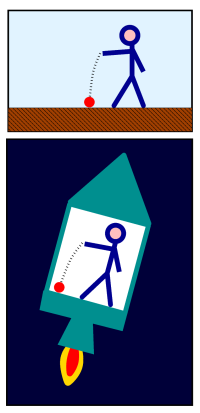
In Robert Dicke’s 1957 paper “Gravitation without a Principle of Equivalence,” he writes about a cosmology where gravitational and inertial mass are implemented differently.
In NPQG, gravitational and inertial mass ARE implemented differently but they are equivalent in the direction of acceleration. In a gravitational field, the Noether cores of spacetime are more oblate (flattened) due to the gradient excitation of spacetime from local concentrated mass which causes the orbital planes of the Noether cores to shift towards alignment. Whereas for an accelerated observer, it is the observer’s Noether cores which have become more aligned, and the core is therefore more oblate. In both cases, the oblate shape is a byproduct of the alignment of the three Noether core orbital planes. So it really is two different implementations. However, the common result is the angle between the orientation of the Noether cores of both spacetime aether and inertial mass emitting matter.
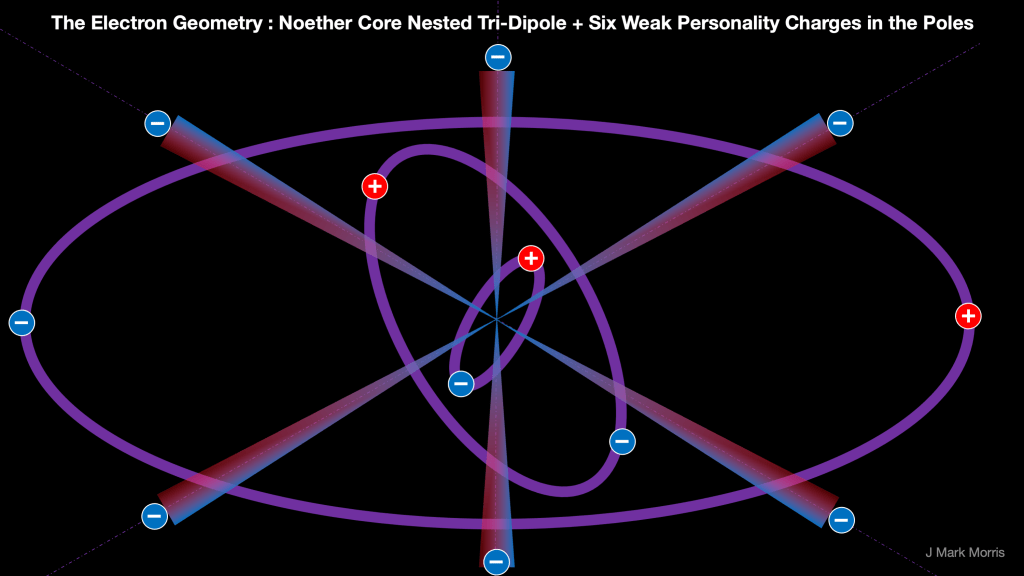


Another way to think about this is to consider the orientation of the orbital planes of each observers particle assemblies versus the orientation and history potential of the Higgs aether assemblies :
| Equivalence Principle? | Observer Assemblies | Higgs Aether Assemblies |
|---|---|---|
| Observer standing on massive body | Experience the force of gravity from the Higgs aether Noether core orbital plane orientation. | Orbital planes of Noether cores tilt making the assembly more oblate. |
| Observer accelerating in deep spacetime | Orbital planes of fermion Noether cores tilt, making the assembly more oblate. This changes the orientation of intra-assembly path history potentials. | Observer’s fermion assemblies excite the Higgs aether as they pass. |
Brainstorm : What if when doing work to accelerate an assembly to higher speed, the Noether cores tilt even more aligned? The farther tilt you go the more effect from history potential. Then when the work stops, the tilt eases to the angle determined by the new velocity. This is fascinating. If this were correct, it would be a whole new way of understanding basic nature, including F = ma. Would it mean that momentum is maintained by history potential of a particle’s Noether core point charges? It makes sense at a high level, because energy is conserved. But could the axial tilting of the Noether core binaries be the implementation? That’s a really interesting thought!
J Mark Morris : Boston : Massachusetts
 Neoclassical