I asked ChatGPT about research on superfluid models of spacetime, specifically regarding where superfluid comes from in those models. ChatGPT gracefully dodged the question, but in doing so, provided context for a new speculative idea that occurred to me. This idea is counter-intuitive at first, yet has the characteristics of “hiding in plain sight” such that it would make sense if correct.

This could be a bizarre idea. I almost rejected it out of hand. Is it possible that spacetime aether, which is so amazing at shielding energy, is created in black holes and emits through the event horizon due to its amazing properties? The ability to pass right through anything with while exerting only gravitational influence is quite a feat. Well, can spacetime aether assemblies also pass right through an event horizon biderectionally?
I’ve been wondering for quite some time how spacetime aether (aka Higgs clusters of pro and anti Noether cores) behaves around a black hole. I had thought of the ideas that perhaps the black hole would ingest spacetime aether at some rate or that perhaps it would somehow deplete the spacetime aether for some distance around the black hole. Neither of those seemed particularly logical nor a good explanatory fit with the NPQG model.
Science says nothing escapes the event horizon except Hawking radiation. However, current science is off track narratively, so its not clear that the model for black holes and event horizons is correct. Furthermore, even within standard astrophysics, most of the discussion is about photons inability to escape a black hole which is a conclusion from GR/QM era physics which does not understand the implementation of photons. Therefore, we can expect that to learn far more about event horizons and the nearby dynamics of assemblies as NPQG matures. And everything can be simulated with NPQG to extremely high precision.
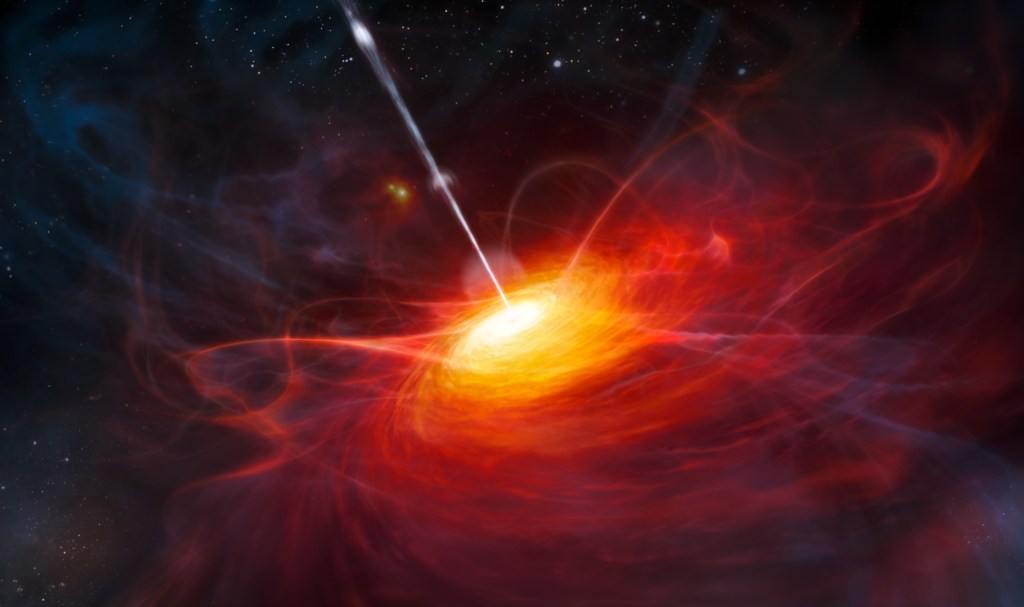
I continue to predict that Planck point charge plasma may, under certain conditions, escape an SMBH via polar jets. This seems explanatory to me in terms of the vast energies of the jets and the distances they travel. However, this is a speculative idea from the early NPQG era.
What about spacetime aether itself? Is it possible that it is emitted by black holes through the surface? It’s seems kind of odd to think of spacetime aether as an output of a reaction, especially at the scale of a black hole. It’s as if the black hole would be outgassing spacetime aether. This would be far more interesting than Hawking radiation. If this mechanism exists, it is yet another case of nature being the trickster, metaphorically.
What else could black hole emission of spacetime aether help explain? Might it have some role in galaxy rotation curves? It might makes sense that an outward spherical spacetime aether wind, which also inflates and expands, would impact galaxy dynamics. I have mentioned before the effect of mass disappearance at a black hole due to superposition. This outgassing of spacetime aether is another mechanism where massy particles could decay and be repurposed into amazingly well shielded Higgs particles.
If it is the case that black holes can emit spacetime aether then this mechanism would need to be factored into the overall set of matter-energy recycling processes. What are the main balancing processes that consume spacetime aether and transmute it into other standard model assemblies? I’ve always presumed that the denser the spacetime aether, the higher the rate of pair production. If so, what proportion of the aether recycling happens in the galaxy center, near the SMBH, or near other BH?
Check out Anton’s video and come back for more insights.
Wow, that got my creativity flowing. This is starting to match up with a lot of ideas. Let me list them in bullet form.
- Dark matter and dark energy each map to shielded energy in point charge assemblies. Shielding of energy is implemented by superposition of the three binaries in each Noether core. Some Noether cores, such as the ones that implement spacetime have near perfect shielding of rather high internal energy. All standard model particle assemblies also contain Noether cores with tremendous, shielded energy.
- Spacetime assemblies get more excited and gain energy the closer they are to dense matter, i.e., in the proximity of a high density of apparent energy emitted by standard model assemblies.
- Excited spacetime assemblies change size and shape
- Overall “orbital volume” shrinks with high energy
- Increased frequency of orbiting sub-assemblies
- N.B. These implement the basis of Einstein’s relativity i.e., stretchy ruler and variable clock.
- Excited spacetime assemblies presumably exhibit more pair production and particle rain.
- So if we imagine spacetime aether from deep space traversing radially towards a SMBH and perhaps inside, what would we observe?
- Deep spacetime near a galaxy :
- Dominated by spacetime assemblies.
- Slight spacetime excitement gradient and resulting distortion, i.e., gravity.
- Lots of photons and neutrinos flying by.
- An occasional hydrogen atom.
- Spacetime near orbs, i.e., asteroids, moons, planets, starts, neutron stars, black holes.
- Dominated by spacetime assemblies.
- Increasing spacetime excitement gradient and shape distortion with denser matter.
- Lots of photons and neutrinos flying by.
- More hydrogen and other atoms, dust, etc.
- Non-polar spacetime near a supermassive black hole (SMBH)
- Same as above, but the spacetime aether is getting rather dense itself and extremely excited, so there are more and varied standard model assemblies and more spontaneous reactions.
- Potentially, an outflow of spacetime assemblies emitted from the SMBH.
- Polar spacetime near a supermassive black hole (SMBH)
- If the SMBH is spinning we would expect to see “frame-dragging” ala Einstein’s general relativity, which would be implemented by the relatively thick and now highly excited spacetime assemblies being spun in polar vortices.
- A logical conjecture is that if the SMBH is spinning fast enough it would be possible for the Planck scale point charge plasma from the core to erupt at the poles in extremely powerful jets.
- I would expect those jets to burn all spacetime assemblies out of their path and thus it may be possible for the point charge jets to be superluminal. Remember, photons are assemblies with a local c speed limit approaches the speed of potential @.
- I expect that simulation will completely illuminate the variety of reactions that would be seen at various stages and positions in, around, and along the jets and terminii.
- Deep spacetime near a galaxy :
- The emerging idea is that SMBH can be the primary galactic recycling center in two distinct ways :
- 1) via spacetime assembly emission, and
- 2) point charge plasma emission via polar jets.
- Could one or both of these be the root cause of the cosmic microwave background?
- Could it be that the spacetime assembly emission “wind” might contribute to the dynamics of galaxy rotation?
- What is the role of mass disappearance in a black hole?
I am becoming more confident in the idea that black holes may emit spacetime assemblies. It makes perfect sense why spacetime point charge assemblies would behave that way and why science has not discovered it, since point charge theory has not yet been seriously considered by the scientific community.
These ideas are the tip of the iceberg, so to speak, in terms of what will be discovered by professional scientists once they embark on the point charge era and apply their considerable talents. What I have imagined here is only the outline of the emerging story. There is much more to learn.
J Mark Morris : Boston : Massachusetts
 Neoclassical