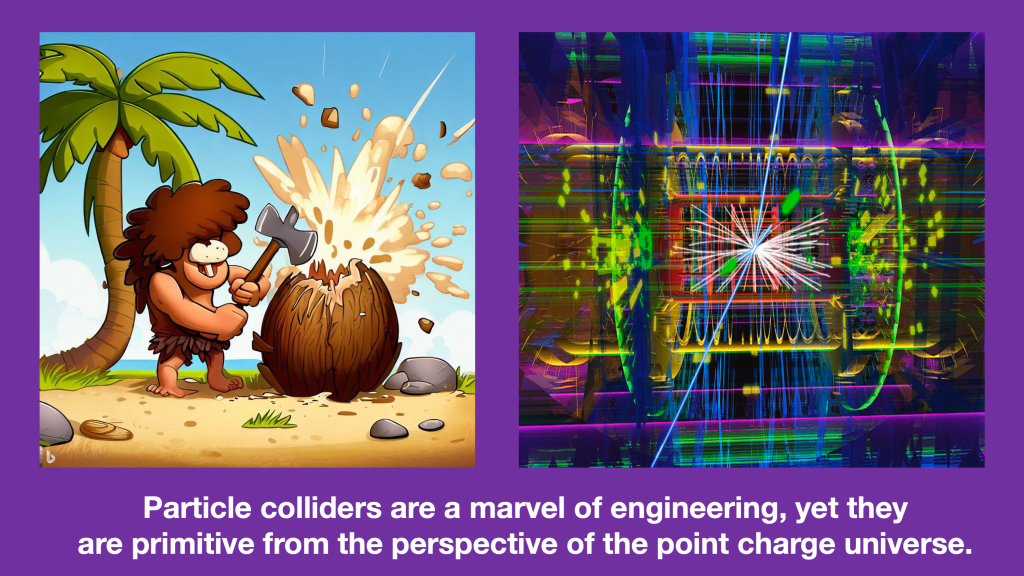
The LHC particle collider costs about 5 billion euros to build and has operating cost of about 1 billion euros per year. The proposed next generation particle collider at CERN is expected to cost over 25 billion euros to build. These are tremendously expensive and unnecessary follies. With the point charge architecture of nature in hand, we have zero need for particle colliders to discover more about nature.
The irony is that the amount of work required to smash together and decay protons (or any other pair of particles) is essentially the work required to decay the generation I and sometimes generation II binaries, revealing the previously shielded energy as apparent energy which we know as mass. This is a simple and not well understood implication of superposition.
We know Noether core superposition is not understood by quantum theory because the standard model does not realize that the generation II and III fermion energies are actually contained in the fermion and shielded to a very large extent.
The point charge assembly architecture explains why the lifetimes of the generation II and III fermions are very short. They are short because they have a decayed Noether core containing either one or two binaries. Based upon the NPQG mapping of known standard model particles to point charge assemblies, a stable Noether core in low energy spacetime aether requires three binaries. Presumably the three binaries orbital paths map to three dimensions of space.
In highly energetic spacetime aether near concentrated matter the lifetime of the generation II and III fermions could very well be longer in absolute time. Perhaps there is some extremely high energy phase or condition where the generation II or III binaries may be reasonably stable. Of course by these energies, it’s likely the personality charges have previously decayed.
I digress. While particle colliders are truly primitive brute force mechanisms they really shouldn’t even exist on our worldline, at least not at the scale and cost they have reached. This is because the point charge assembly architecture should have been discovered circa 1900 – 1920. The failure to discover the point charge architecture has caused 125 years of narrative confusion due both to general relativity and quantum theories. It is important to acknowledge that the maths of GR and QM match well with observations, yet even that progress has been extremely slow in comparison with an alternative timeline where point charge assemblies had been imagined by 1900.
In the point charge era, the true art will be in discovering ways to tap into shielded energy as well as to transmute point charge assemblies safely. There will be many technologies that aim to tap into shielded energy in matter or even spacetime. A step beyond is to transmute the point charges of input reactants into a useful output product.
Furthermore, common sense suggests that such technology developers must ensure that such processes are safe for workers and the environment. This means that the art of design and engineering for such processes must optimize for zero radiation and have mitigation for any low level escapes, as well as failsafes for catastrophes. Ideally, spacetime aether may become the ultimate green energy and raw materials source.
 Neoclassical