This is profoundly amazing, but particle physicists only examined a single ideal geometrical point charge system formulation during the classical to quantum transition, ~1900:1925. It was correctly falsified. However, no other point charge systems appear to have been examined. How many can you imagine if these are the four characteristics you are allowed to change?
1. the charge magnitude |q|, i.e., the unit of charge. Express it relative to |e|. Of course, one could imagine infinite point charge systems with a large number of different magnitudes of point charges, but let’s keep it to just one magnitude, i.e., |q|.
2. the speed of the potential wave emitted by the point charge which we will label @. Is @=c?, @>c?, @>>c?, @<c? something else?
3. the maximum speed of the point charge itself. is it equal to c, greater than c, or unlimited? or something else?
4. the physics of point charges. How is action defined? Do potential waves interact? Which areas of classical physics can we use or adapt?
Assume the background is a truly empty Euclidean 3D space and linear time. Assume that point charges and their emitted potential can move through time and space. Also assume that on a very large scale the density D of point charges and the energy density E that is carried by those point charges are nearly constant throughout the large-scale universe.
Interestingly, if you really wanted to dream up point charge systems, there are an infinite number of them. Does any one of them match our universe?
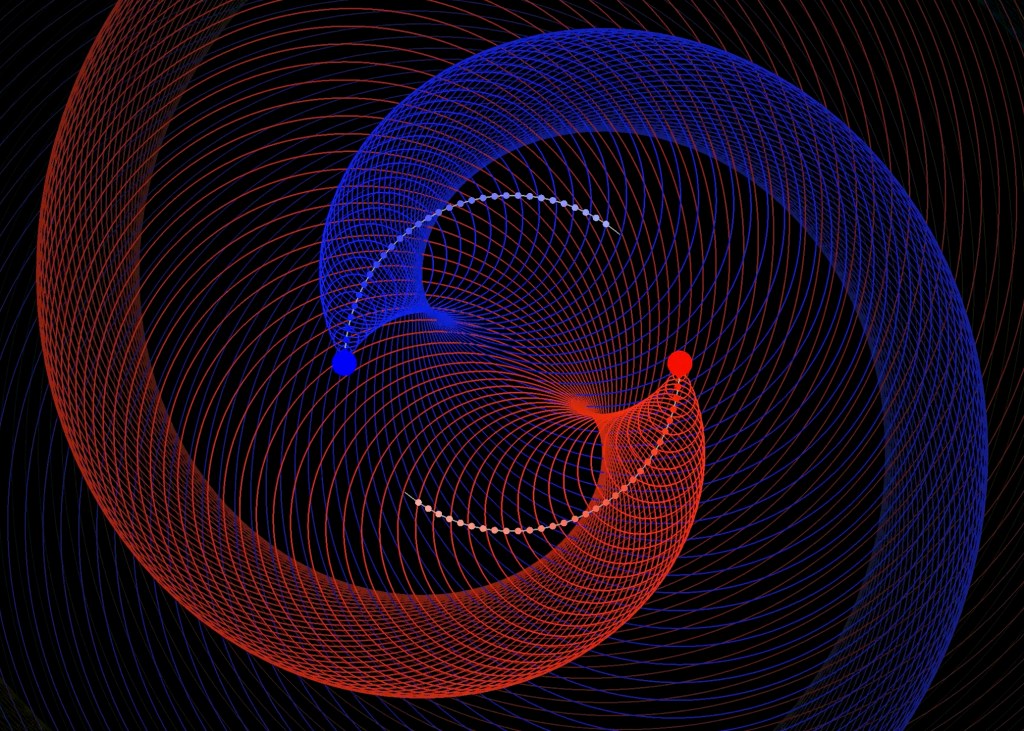
The image shows the primal (i.e., most primitive) assembly of two point charges, -q and +q. The concept of “assembly” is a key one, as we have now taken the reductionist path to solving nature. We are looking for an architecture that assembles into the standard model of physics and produces the behavior described by general relativity and quantum theory and confirmed experimentally.
The image shows an orbiting point charge binary assembly. The depicted system is defined where point charge speed can exceed the speed of the potential they emit. The tracer circles show the 2D crossing of the spherical potential emissions, which fade at 1/radius. The superposition of the potentials is fascinating when you consider that a virtual observer would see enormous spiral waves of potential cresting and falling and cresting and falling all the while fading with distance.
This is an enormous $$$ unexplored opportunity for new mathematics and Ai assisted simulation.
J Mark Morris : Lynn : Massachusetts
 Neoclassical