This is a brainstorm post.
Bosons are “force particles” and have spin-1 and can be represented as vectors.
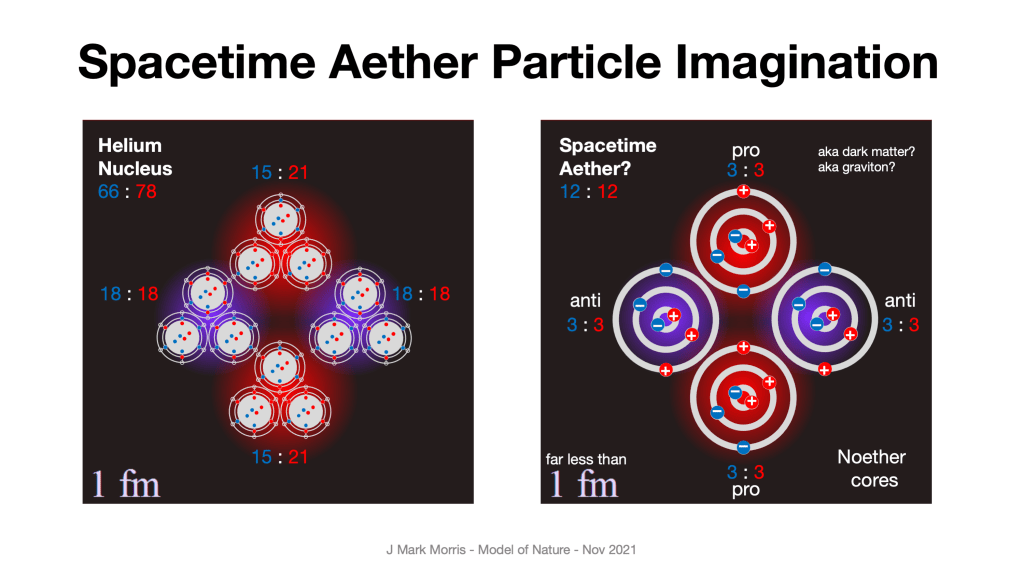
Interestingly, as I map to point charge theory, all boson’s appear to be a relationship between two Noether cores:
- Gluon: relationship between binaries in different Noether cores inside a nucleon, e.g., proton or neutron.
- W’s and Z: relationship between Noether cores of particles in a reaction. (Check my W slide.)
- Photon: relationship between contra-rotating Noether cores that make the photon assembly.
So that is a rather amazing insight.
Why would these be considered force particles in terms of point charge theory? I suppose like the binaries in experiment 1 they seem to tractor beam on to other binaries. Somehow the potential superposition and action serves as some sort of vortex that binds things together (gluons and photons) or drives them apart in the case of W’s and Z? That last part is very tenuous speculation, but fascinating if at least directionally true. I guess it sort of makes sense, if some pairs of Noether cores attract, then other pairs of Noether cores may repel. Alternately it may be that the personality charges in the mix are essential to W and Z behaviour. These are all ideas worth exploring.
The Higgs has spin-0 and is represented by a scalar. Higgs is well shielded and it is extremely lightly interactive. The poles barely interact. Plus, in a Helium like configuration, the two pro and two anti Noether cores may already couple to a large or possibly complete extent. Let’s see. With 4 Noether cores, we have 24 poles. If the 12 anti-Noether core poles could somehow couple with the 12 pro-Noether core poles all the slightly active portions of these assemblies are muted.

Universe Today
The binaries in the spacetime aether assemblies are extremely high energy. We don’t know if the Higgs apparent energy (mass) represents the Gen I, II, or III binaries in the aether assembly. Shall we presume that binary couplings only occur between the same generation i.e., I and I, II and II, III and III? Seems logical, but who knows? For any given pro core, can it have couplings to two anti-cores in different generations and vice-versa? That would make sense, to bind the overall 4 assembly cluster together. Do the relationships change over time, like presumably those for each gluon change?
With all the poles coupled in an aether cluster, is that what makes it spin 0? No perceived spin?
Whereas in the photon, gluon, W’s, and Z we have planar Noether cores. The gluon is coupled most of the time. The W’s and Z’s “couple” or transit only in reactions. The photon is like a long distance reaction that starts at the point it is spun up and launched and may end with a Noether core interaction when it encounters a matter assembly.
That leaves the spin 1/2 particles which are the fermions. They are represented with spinors. Their Noether cores are not planar. The binary axes precess with a period of 2 cycles, thus spin 1/2.
J Mark Morris : Lynn : Massachusetts
 Neoclassical